
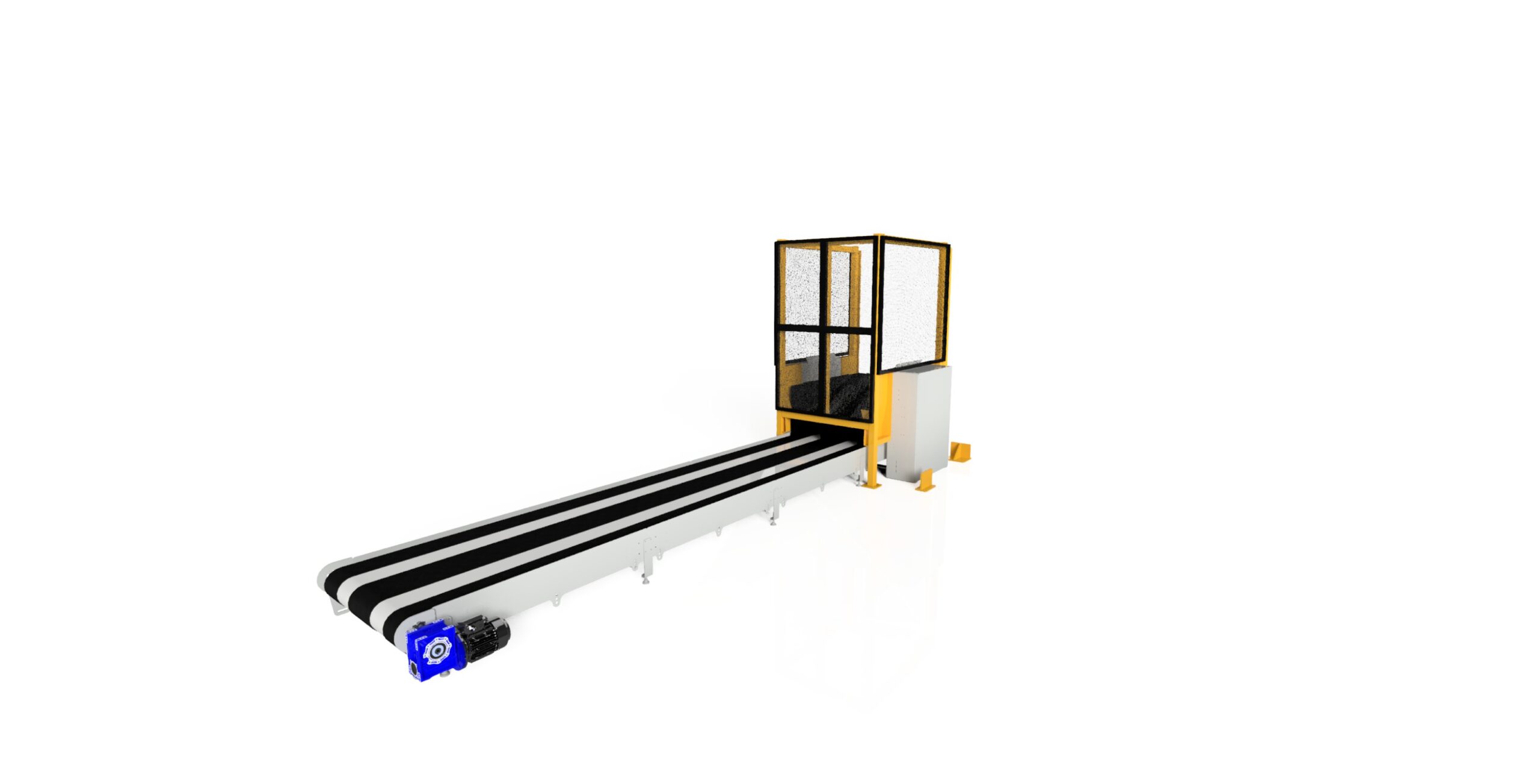
Pallet stacker: the benefits of automation over manual stacking
Stacking empty pallets by hand is an underrated problem in production plants. Find out when and why a pallet stacker delivers measurable savings in time and cost, improves operator safety and reduces physical strain.
Every production plant that works with pallets faces the same problem: empty pallets pile up at the end of the line and someone has to carry them away, store them and prepare them for reuse. Or the other way round, when pallets need destacking — a logistics operator brings a stack of empty pallets and the line operator then takes them off one by one to load products. Manual handling costs operator time, raises the risk of injury, is physically demanding and often damages the pallets themselves. An automatic pallet stacker solves these problems at the point where they arise — with no operator intervention and no downtime.
In this article we compare the two options from a practical point of view: throughput, safety, cost and suitable use cases, so you can judge whether investing in a stacker is justified in your own plant.
What a pallet stacker is and how it works
A pallet stacker is used mainly in two configurations:
- Outfeed stacker — it automatically collects empty pallets from the conveyor system or the end of the line and stacks them one on top of another. When the stack reaches the set height (typically 8 – 12 pallets), the machine releases it and clears the space for the next cycle.
- Infeed destacker — the machine is loaded with a whole stack of pallets and then feeds them out one at a time to the operator or onto a conveyor belt.
The whole process runs without an operator and without interrupting production.
Manual stacking: the hidden costs nobody invoices
At first glance manual stacking looks like a zero investment. In practice it is a recurring burden on the operator, and it shows up in several places.
Operator time: At 100 – 200 pallets per shift, one worker spends 30 – 60 minutes on the handling alone. Over a year that is 120 – 240 hours of working time spent on a task a machine handles without downtime.
Injuries and sick leave: Pallet stacking is a musculoskeletal load, and those are among the most frequent causes of workplace injury in industry. A damaged spine, a pulled muscle — every injury means wage compensation and a gap on the line.
Pallet damage: Incorrect manual stacking often cracks the boards or breaks the edges of wooden EUR pallets. The cost is not only buying new pallets, but also the logistics of sorting and scrapping them.
From practice: In a food plant running 150 pallets per shift, after commissioning a stacker we recorded a drop to zero in injuries during empty-pallet handling and a saving of roughly 25 minutes of operator time per shift.
Pallet stacker: the concrete benefits on the shop floor
1. Line continuity with no downtime
The operator does not have to leave the workstation to carry pallets away. The line runs without interruption and the production rate stays stable. The machine itself signals when the stack is full — the operator simply removes it with a forklift.
2. Less physical strain and lower injury risk
Stacking a EUR pallet weighing 10 – 15 kg to a height of 1.8 m is a risky operation. The stacker performs it mechanically, in a precisely defined cycle, with no risk to the operator.
3. Floor space saved
An automatic stacker builds a compact stack with a minimal footprint. Compared with manual stacking, where pallets often pile up in disorder, it saves 5 – 10 % of the plant floor area around the line.
4. Correct orientation and stack quality
The machine always places pallets in the same orientation and alignment. For plants that return EUR pallets into circulation (the exchange system), that is a key criterion at goods-in inspection.
5. Integration with the conveyor system and MES
Modern stackers connect to the line PLC over Profinet or digital I/O and send status signals to the higher-level system. Plant management knows in real time how many pallets have been processed and when intervention is needed.
Which plants benefit most from a stacker
A pallet stacker is not for everyone. Based on experience from projects in Slovakia and the Czech Republic, we suggest considering the investment if at least two of the following apply:
- The plant handles more than 80 pallets per shift
- Line operators regularly lose time carrying empty pallets away
- The plant has had injuries or musculoskeletal complaints during pallet handling
- Pallets are returned into circulation and their correct orientation and integrity matter
- The production line is connected to, or planned for, a conveyor system
For plants running under 50 pallets per shift and with no conveyor automation planned, manual handling usually remains the economically sound choice.
Technical data: what to ask about when choosing
- Pallet type: EUR (1,200 × 800 mm), chemical (1,200 × 1,000 mm), plastic — the machine has to match your format
- Stack height: 6 – 12 pallets as standard, some versions up to 2,200 mm
- Load capacity: a EUR pallet is 10 – 15 kg, total stack capacity is usually 300 – 600 kg
- Drive type: electric (quieter) vs. pneumatic (simpler to service)
- Integration: Profinet, DeviceNet, digital I/O
- Safety features: light curtains, mechanical stops, emergency stop
If you have no conveyor system in the plant, a conveyor and a stacker are always designed together as one functional unit — sizing them to each other is the key to the right cycle. More about our pallet stackers and destackers is on the product page.
FAQ — frequently asked questions
How long does installing a pallet stacker take?
A standard installation, including connection to an existing conveyor system, takes one day. If the conveyor route has to be extended, the project takes longer depending on its scope. We always carry out a FAT (Factory Acceptance Test) before dispatch, which minimises commissioning time on site.
Does the stacker work with plastic pallets too?
Yes. We configure the machine for the specific pallet type — EUR, chemical, plastic or metal. What matters is setting the stops and drives correctly for the weight and size of the pallet. One stacker normally works with a single pallet type — if a plant mixes several formats, separate lines are sometimes the better answer.
What is the service life and what maintenance does it need?
Pallet stackers are mechanically simple machines. With regular preventive maintenance (lubrication, checking the sensor optics, checking the seals), a typical service life is 10 – 15 years. Preventive maintenance is normally scheduled once a year.
Do I have to replace the whole line, or can a stacker be added to an existing plant?
Adding one is the usual scenario. The stacker connects to an existing conveyor, or a short linking conveyor is added. Before the project we measure and assess the space so the solution fits without building work.