
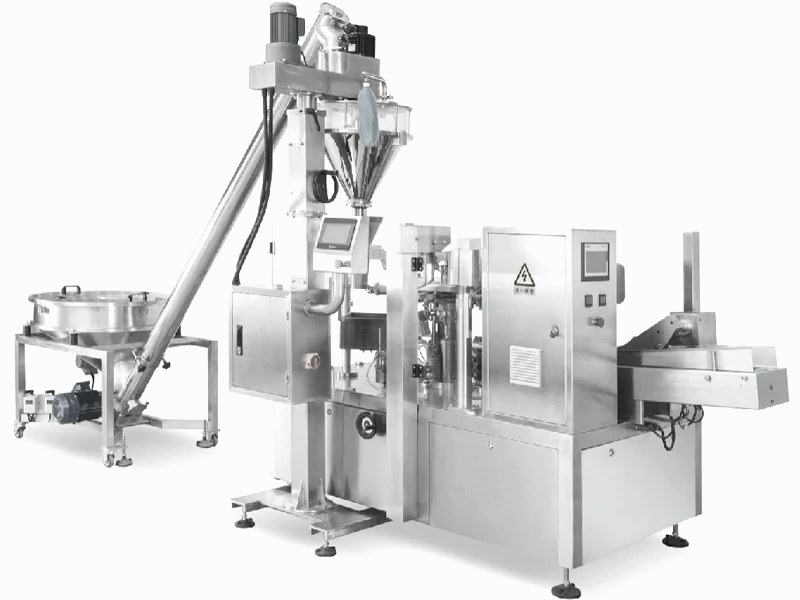
Filling products into tubes and pouches: from the filler to the transport pack
Gels, creams, powders and loose piece goods have one thing in common: the dosing accuracy into the pack decides both material cost and the number of complaints. Read how a line is designed, from the tube and pouch filler through to packing into transport boxes.
Producers of gels, lubricants, cosmetics, food supplements, loose goods and powders all reach the same breaking point as volumes grow. Filling tubes by hand, or dosing into pouches and crates by hand on a scale, works for small batches; as unit counts rise, four things start to show: the spread in the dosed weight, the risk of contamination, labour cost and unstable seal quality.
The spread in the dosed weight is the most expensive of the four. A producer who doses with a tolerance of +3 % above the nominal weight, so as never to fall below the declared value, is giving product away. With more expensive products — collagens, vitamin concentrates, technical gels — that loss shows up in the bottom line and in competitiveness.
Contamination is the other side of the same coin, and it is usually far worse in cost terms. In manual filling and manual transfer, a metal fragment from a tool, dirt from gloves or a foreign object from around the workstation finds its way into the product. The difference from a dosing error lies in the consequence: an inaccurate dose costs a few per cent of material, while contamination can mean pulling an entire batch from the market, a report to the state authority, a penalty from the retail chain and the loss of trust that took years to build. An automated line reduces that risk in two ways — it limits operator contact with the product and it allows metal detection and vision inspection to be placed directly in the flow.
In this article we go through the whole flow: choosing the dosing principle according to the product’s properties, the differences between a tube and a pouch, hygiene requirements and weight checking and finally secondary packaging — placing primary packs into boxes, transport pouches or crates. Deliberately in this order, because a mistake in choosing the primary pack carries through to the whole rest of the line.
What the flow from filler to pallet looks like
Although every project is designed around a specific product, the sequence of operations is the same in most plants:
- Pack preparation — tube magazine, film reel or infeed of empty crates, feeding, print orientation (on tubes by the registration mark)
- Dosing — volumetric or gravimetric filling of the product
- Closing — tube seal (hot air, ultrasound) or pouch seal; metal and laminate tubes are crimped
- Marking — production date, batch, best-before date where required
- Inspection — checkweigher, metal detection, seal inspection, vision inspection of the print
- Secondary packaging — grouping, placing into a box or transport pouch, taping, label
- Palletising — stacking on the pallet and wrapping
The critical point is not the filler, but the transitions between operations. If the filler manages 60 tubes per minute and the case packer handles 40, the whole line runs at 40 and the investment pays back far more slowly. Sizing the cycle across the entire route is therefore the first step of the design, not the last.
Dosing by product properties: from gels to powders
The choice of dosing principle follows from the product’s properties. For liquid and pasty products, what matters is viscosity, the presence of solid particles, the tendency to foam and sensitivity to shear. For loose and powdered products it is flowability, particle size, dustiness and the tendency to cake or bridge in the hopper.
- Piston dosing — the most common solution for medium- and high-viscosity products: gels, creams, pastes, lubricants. Volumetric, well repeatable, and it copes with products containing particles if the valve is properly sized. The dose size is easy to adjust.
- Peristaltic pump — low to medium viscosity, hygienically advantageous because the product touches only the tubing. The tubing is a wear part, which simplifies both sanitation and batch changeover.
- Rotary and gear pump — continuous dosing of viscous products without particles, suitable at higher throughput.
- Auger doser — loose and powdered products: proteins, instant mixes, powdered supplements. With dusty products, extraction and sealing of the filling head have to be solved, or dust reaches the sealing surface.
- Vibratory and hopper dosing with a scale — loose piece goods such as sweets, granulates or nuts. The product falls from a closable hopper into the pack and filling is ended by the signal from the scale beneath it.
- Gravimetric filling — dosing with feedback from a load-cell scale. Used where the product is expensive, or where volumetric filling fails because of unstable density and foaming. Slower than the methods above.
The difference between volumetric and gravimetric filling is not merely technical. Volumetric dosing is simpler, faster and cheaper, but it reacts to changes in the product’s density, temperature and flowability. Gravimetric dosing achieves better accuracy and allows the safety overfill to be reduced, so the investment pays back directly on material. With products that carry a high price per kilogram, that is usually the decisive argument. More about the dosing options is on the page filling and dosing of products, and we also handle accurate weighing separately as part of product weighing.
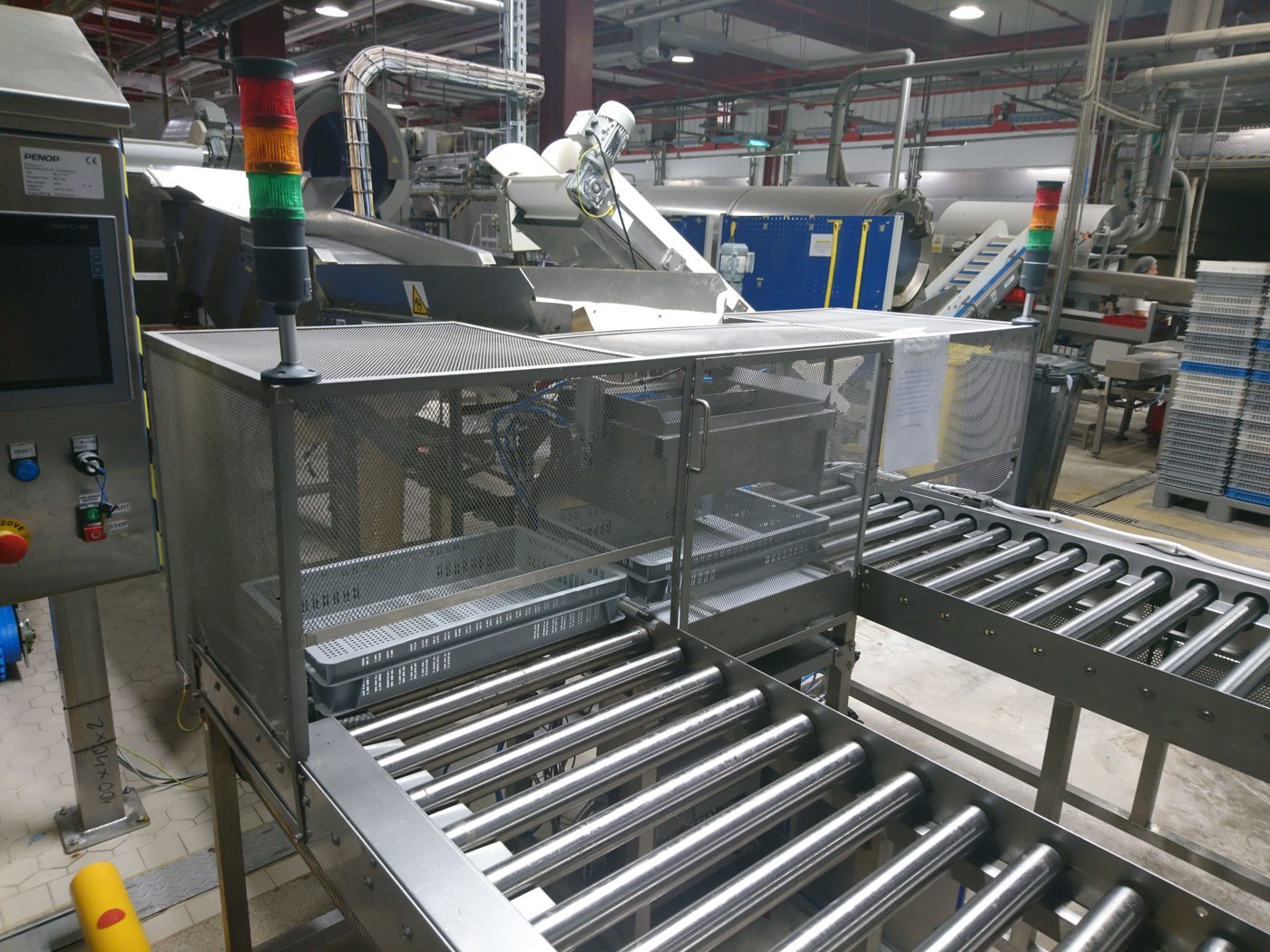
From practice: For a confectionery producer we supplied automatic weighing of sweets into crates. The workstation is U-shaped with driven roller conveyors, and a pneumatic pusher moves the crates one position at a time. Beneath a closable hopper there is a scale — once the required weight is reached, the hopper closes and the crate moves off onto the outfeed conveyor. Four opening vanes in the hopper distribute the sweets evenly. The line achieves 5.2 t/h at a dose of 5.5 kg per crate, which is a 3.75 s cycle. The scale is accurate to 5 g and the weighing accuracy is within 100 g. A crate outside tolerance is signalled at the end of the line by a red beacon so the operator can top it up by hand. Recipes are selected on a touch display, and the concept is ready for a robotic palletiser to be added.
Tubes or pouches? What decides the primary pack
Both formats can be filled automatically, but they place different demands on the line.
Tubes
A tube arrives as a finished pack — plastic, laminate or aluminium. The filler takes it from the magazine, turns it into the correct position by the registration mark, fills it from below and closes it. Plastic and laminate tubes are sealed with hot air or ultrasound; aluminium ones are crimped and folded.
Advantages: a rigid pack, repeated dosing for the end customer, good print quality, and protection against air ingress with aluminium. Disadvantages: a higher pack cost per unit, more volume in transporting and delivering empty tubes, and a more demanding format change.
Pouches and stick packs
A pouch is most often formed in the machine itself from film on a reel — a vertical form, fill and seal machine makes a tube of film, seals it, doses the product and closes it. For single doses of gels, powders and supplements a stick pack sealed on all four sides is used; for larger volumes a doypack with a spout.
Advantages: a low pack cost, minimal storage volume for the film, high output, and a single dose with no need for a measuring cap. Disadvantages: a mechanically less robust pack, stricter demands on seal quality, and a tendency for product to contaminate the sealing surface — above all with sticky gels and dusty mixes.
A practical rule: if the customer doses the product more than once, a tube makes sense. For a single portion or a sample, a pouch wins on both cost and output. Plenty of producers use both formats at once — and then the decision is whether to build one convertible line or two separate routes. Conversion means a lower initial investment but lost time at every batch change. On top of that, the output of one convertible line is far lower than that of two separate ones — which shows up in full only when you calculate the cost per packed unit.
Hygiene and cleanability: where the most expensive mistakes are made
With food, cosmetics and food supplements, sanitation matters as much as output. A machine that takes two hours to clean reduces line availability more than a fault once a month.
- Materials in contact with the product — food-grade stainless steel, seals and tubing certified for food contact
- Dismantling without tools — the dosing valve and piston should come out by hand; this is the biggest source of time savings at a batch change
- Design with no dead zones or horizontal surfaces — no blind spots where product would remain and age
- CIP where it makes sense — with frequent batch changes, cleaning in place is worth it; with a single product, dismantled cleaning is usually more practical
- Protection of the electronics — wet cleaning calls for an adequate IP rating and for water to drain off the frame. The material also has to suit the composition of the products being made. Starch, for example, makes the rubber insulation of cables and wires brittle, and that has to be allowed for.
We recommend treating weight checking as part of the line, not as an added step. A checkweigher placed after the filler reveals a deviation during the shift and, when linked into the control system, can correct the dosing automatically. Badly filled units are rejected before they reach secondary packaging — pulling a faulty unit out of an already taped box is always more expensive. The same applies to metal detection: the earlier it sits in the flow, the fewer finished packs have to be scrapped.
Secondary packaging: from primary packs into boxes and transport pouches
The second half of the line usually gets less attention during design, even though in many plants this is where most of the manual work sits. Filled tubes or pouches have to be counted, grouped and placed into a transport pack.
Four approaches are used in practice:
- Packing into boxes — the box is folded and formed, products are placed in from the top or the side, and the box is taped and marked. Suitable for stackable packs and for distribution to retail chains. This step is covered by case packers for products.
- Packing into transport pouches — a group of primary packs is dosed into a larger pouch, which is then sealed. Cheaper than a box, more space-efficient, and suitable for deliveries for further processing or for e-shop dispatch.
- Weighing into crates — with loose piece goods the product is often not dosed into a primary pack at all, but straight into a crate for internal handling or further processing. What matters is the dosing accuracy and an even distribution of the products in the crate.
- Grouping in shrink or stretch film — a multipack without a box, used for promotional packs and for pouches.
Placing product into the transport pack is most often done by a machine with a vacuum or mechanical head, or by a robot if formats change often. A robotic solution costs more, but converting to a new format is a matter of the program rather than a mechanical change — with a wide product range that pays off.
Two things come up again and again in projects and have to be allowed for: counting or weighing the units and product orientation. If the system does not know the exact count in a box, one missing unit at the customer triggers a complaint about the whole batch. And if the print on a tube is to face the same way inside the box, that has to be solved at filling, not at insertion.
When automation pays off and what to ask about
When to consider the investment
Automating filling and packaging usually pays off if at least two of the following apply:
- The plant runs two or three shifts and manual filling has become the bottleneck
- The product has a high price per kilogram, so the safety overfill in dosing costs real money
- The customer or an industry standard requires documented weight checking and batch traceability
- The plant carries a high contamination risk — food, food supplements, pharmaceuticals — and manual handling of the product is still routine
- The product range is stable — few formats, large batches. With dozens of formats in small batches, consider the changeover time and lean towards a flexible line instead
- Downstream of filling there already is, or is planned, a conveyor or palletising systemto connect to
Questions for the supplier
- Product: viscosity or flowability, presence of particles, filling temperature, tendency to foam, chemical composition
- Dose range: the smallest and largest volume on one machine
- Accuracy: what deviation is guaranteed, and at what throughput
- Pack formats: tube diameters and lengths, film width, crate dimensions, seal type
- Changeover time between formats, and whether a tool is needed
- Sanitation: the cleaning procedure and time, dismantlable parts
- Integration: Profinet or digital I/O, transfer of batch data to the higher-level system
- Safety: guarding of moving parts (for example perforated stainless sheet with openings up to 10 mm), light curtains, emergency stop, protection of the machine against being hit by a forklift
- FAT before dispatch on the real product and the real pack
The last point matters more than it seems. A gel behaves differently with water in a test room than in production at 22 °C, and a powder behaves differently at 30 % humidity than at 60 %. A trial with your product and your pack before dispatch shortens commissioning on site and reveals problems with the seal, with dripping or with dusting while the machine is still at the supplier.
FAQ — frequently asked questions
Can one filler handle both tubes and pouches?
The dosing unit is usually shared, but handling the pack differs — a tube is fed from a magazine, a pouch is formed from film. In practice they are therefore designed as two stations with one dosing principle, or as two separate routes. Which is better depends on each format’s share of total volume.
What dosing accuracy can be achieved?
It depends on the principle and on the product. Volumetric piston dosing achieves good repeatability at a stable density; gravimetric filling with feedback from a scale is more accurate and allows the safety overfill to be reduced. We only determine the guaranteed deviation after a trial with your product — catalogue figures may not hold up with sticky gels, foaming mixes and dusty powders.
How can the risk of product contamination be reduced?
By three things at once. The first is limiting operator contact with the product — the less manual transfer, the fewer opportunities to introduce a foreign object. The second is design: food-grade stainless steel, no dead zones or horizontal surfaces, guarding on moving parts. The third is detection — a checkweigher, a metal detector and vision inspection placed as early in the flow as possible, so a rejected unit does not have to be hunted for in an already taped box.
How long does changing over to another tube or pouch format take?
On a well-designed machine it is a matter of changing the format parts and selecting the program. What decides it is whether the parts come apart without tools and whether the change is stored in a recipe. If you plan frequent format changes, put that in the specification at the outset — modifying an already built machine afterwards is always more expensive.
Do we have to replace the whole line, or can a filler be added to existing production?
Adding one is the usual scenario. We connect the filler to an existing conveyor or add a short linking route, and tie in the secondary packaging. Before the project we survey and assess the space, so the solution fits without building work and the cycle matches the rest of production.